

THE UNFAIRNESS OF NOW: Leading When the Ground Shifts

Updated: Dec 11, 2025
"It is not fair."
These four words are perhaps the most human reaction to loss. We whisper them when the restructuring announcement hits our inbox on a Friday afternoon. We feel them when the country we have built a life in tightens its visa rules, reminding us that despite our titles and taxes, we are only ever guests. We think them when we realize the organizational chart is flattening, and the rung of the ladder we just reached is being removed.
They are the knee-jerk defense mechanism of a spirit that is trying to hold onto a reality that no longer exists.
For the past two decades, the path was clear: Work hard, gain expertise, climb the ladder, accumulate status. But today, the "middle" is collapsing. We are witnessing a "delayering" of organizations where the heavy lifting of management—oversight, coordination, reporting—is being handed over to algorithms or flattened into non-existence.
In a recent coaching session, a client named Sonia brought this struggle into sharp focus. On the surface, her challenge was physical—a pinched nerve that stopped her from performing the high-intensity workouts she loved. But underneath the physical limitations lay a profound systemic struggle that mirrors exactly what middle and upper managers are facing today.
Sonia was a "tire flipper." She defined herself by her capacity to handle intensity. She was the one who could grind through the hard stuff. Then, in a moment that "startled" her, that capacity was taken away. She was left looking at a new landscape, wondering: If I can’t do the heavy lifting anymore, who am I?
Whether it is a body that won't cooperate, or a career track that has suddenly evaporated due to AI and cost-cutting, the feeling is the same: The rules have changed, and I am grieving the person I used to be. I. The Wake-Up Call: The Squeeze on the Middle
Every transformation begins with a rupture. It is a signal that the old way is over. For Sonia , it wasn't a subtle shift; it was a physical halt. She describes a history of vibrancy: "I used to do like a lot of HIIT workouts... flip tires... I used to dance as well". Her identity was wrapped in motion, strength, and the camaraderie of "really great trainers".
Then came the wake-up call. It started as "pains in different areas," culminating in a diagnosis of a pinched nerve. The severity was shocking; she found herself in a position where she "couldn't really tie my shoe".
For the modern leader, the "pinched nerve" looks different, but feels just as paralyzing. It appears as the Silent Squeeze:
The Loss of Authority: You are an upper manager, but decision-making is being centralized by data dashboards or decentralized to agile teams. You are squeezed from both sides.
The "Expat" Uncertainty: You have built a career in a global hub, only to find that localization policies are tightening. The ground beneath your feet—your residency, your children’s stability—suddenly feels fragile.
The AI Disruption: You spent twenty years mastering a technical domain. Now, a junior associate with a Large Language Model can produce 80% of your output in 10% of the time. The "heavy lifting" you prided yourself on is no longer a premium skill.
Sonia noted, "I never really got back to working out the way I was used to". This is the hard truth many leaders are facing: The market is not going back. The structure of work has permanently shifted.
We see the signs. We feel the "pain in different areas"—the budget cuts, the hiring freezes, the subtle exclusion from strategic meetings. But often, we misinterpret them. We think, I just need to work harder. I just need to survive this quarter. We treat the systemic shift as a temporary glitch. But as Sonia realized, this was a "new development" that demanded a new response
II. The Realization: "I Can’t Do That Anymore"
Once the acute crisis fades, the chronic reality sets in. This is the phase of Comparison and Frustration.
Sonia describes a painful cycle of looking at the external world and measuring her current incapacity against it. She goes on social media and sees folks "doing all these different things that I used to do". The realization hits her hard: "I can't really do that anymore".
For the high-performing manager, this is the "Gap of Grief." It is the gap between the status you think you should have and the reality of your current influence. You look at LinkedIn and see peers pivoting effortlessly (or so it seems). You see younger leaders adapting to chaos "with ease", while you feel bogged down by the complexity of legacy systems and outdated expectations.
Sonia confessed her deeper anxiety: "I don't want to like gain weight and... just kind of start to experience negative things". She feared a "downward spiral".
This is the hidden fear of the corporate "Living the Edge" experience: Irrelevance. The fear that if we stop "flipping tires" (working 60 hours, putting out fires, being the hero), we will "gain weight" (become sluggish, obsolete, and discarded).
Sonia felt the unfairness of it. "I'm over the fact of saying, Hey, it's not fair," she told me. Yet the sentiment lingered. She insisted, "It's not that I'm lazy or anything".
This defense—I am not lazy—is the mantra of the burnt-out manager. We work harder and harder to prove our value, not realizing that the definition of value has changed. As Robert Kegan's theory of Adult Development reminds us:
The crisis of leadership today is not a crisis of skill, but of identity. We are being asked to let go of the 'self' that knew how to win, to make space for a 'self' that knows how to adapt.

III. The Internal Conflict: The Parts of the Self
Why is acceptance so difficult? Why couldn't Sonia simply say, "Okay, I'll walk instead of run"? Why can't a Director simply say, "Okay, I'll guide instead of do"?
To understand this, we have to look at the different parts of ourselves that govern how we think and respond. Sonia's struggle—and yours—is a civil war between these internal parts.
1. The Manager (The Strategist/Fixer)
This part of you wants to solve the problem to maintain control. It is the part that says, "I'm not lazy". To quell the anxiety of the "downward spiral," this Manager part springs into action. For Sonia , the Manager bought a solution: a new bike. "I've recently bought a bike that I saw that's really cool... It's like an elliptical bike that you can use outside". The Manager loves this strategy. It tells her, "See? You are still active. You are breaking a sweat". In the corporate context, this is the leader who, facing deep uncertainty, buys a new productivity tool, reorganizes the team again, or signs up for a generic MBA course. It is a frantic attempt to do something to prove we are still in the game.
2. The Exile (The Griever)
Deep down, buried beneath the busyness, is a vulnerable part holding the pain of loss. Sonia admits that "a part of me, like, is gone". This part misses the connection, the relationships, and the "challenge" of the old life. The Manager buys the bike (or the new software) specifically to keep this Exile quiet. To keep the sadness of what we are losing at bay.
3. The Critic (The Comparator) This part looks at the market and whispers, "Everyone else is figuring this out but you." It generates the shame and the feeling that your current efforts are "blah".
The internal conflict arises because the Manager (the bike strategy) is trying to override the Exile (the grief). Sonia tried to convince me that the bike was the answer. She claimed, "I am feeling some positive emotions when I'm using it". But as I listened, I couldn't buy it. I told her, "Right. And those are nice words, but it's not something you believe".
This is where many senior leaders are stuck today. They are using strategies (bikes) to pretend they can still flip tires. But as Theory U suggests regarding our patterns of response:
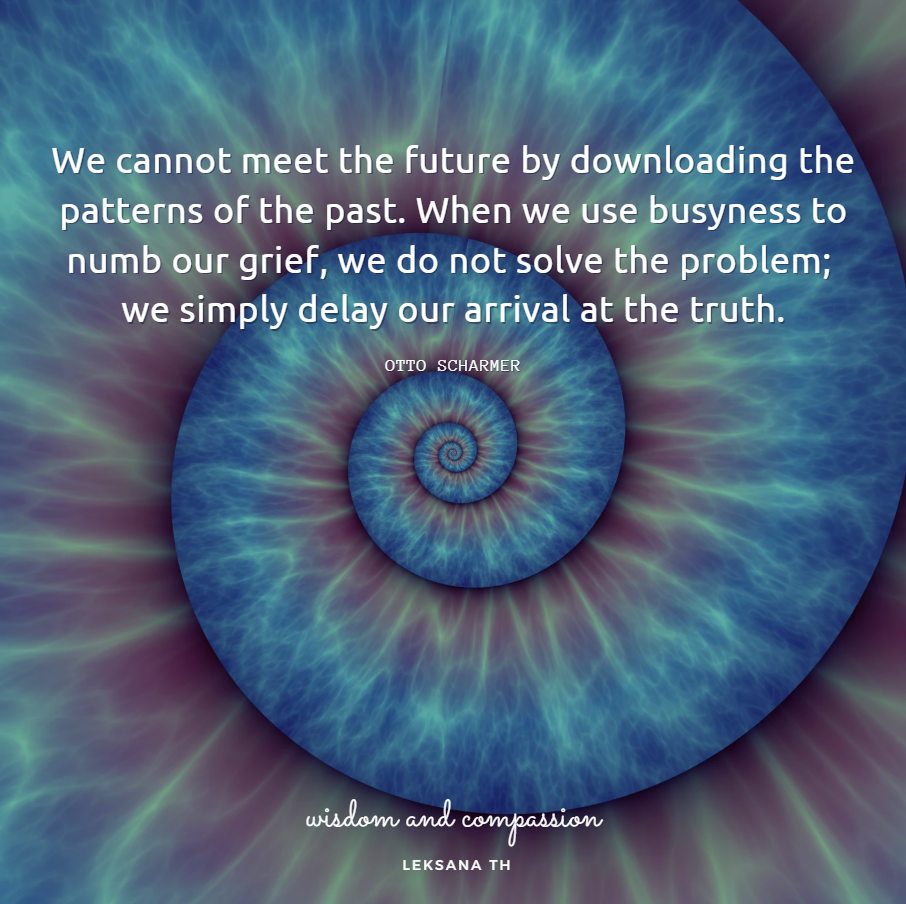
We cannot meet the future by downloading the patterns of the past. When we use busyness to numb our grief, we do not solve the problem; we simply delay our arrival at the truth.
IV. The Dialogue: Moving from Strategy to Soul
Transformation requires a disruption of the internal narrative. In our coaching session, that disruption came when we refused to focus on the bike and focused on the person riding it.
The Mirror Question At one point, a reflective question was asked to Sonia . It was about what she could see herself in a mirror. This question bypassed the strategy and spoke directly to the vulnerability. Sonia admitted she wasn't obese, but she wasn't in that "optimal shape" where she felt amazing. It exposed the gap between her reality and her self-image.
The Strategy vs. The Acceptance I gently challenged the "bike" defense. When Sonia argued she could find alternatives, I pushed back: "My point... is that just finding an alternative is not what's going on here. It's having you accept this is where you are". I identified that her search for alternatives was a "positive excuse" to avoid the real work.
Naming the Grief The breakthrough happened when we gave the feeling a name. I shared my observation: "It sounds like a grieving process in some ways". This was the key. Sonia had been treating her situation as a logistical problem (I need a new workout), but it was actually an emotional problem (I am grieving my old identity). Sonia finally admitted: "I knew that it was a grieving process, but I didn't realize how significant it was". She realized that her old life was a "chapter that I'll have to close".
This is the pivot point for every leader facing the "Edge." You cannot strategize your way out of an identity crisis. You have to grieve the leader you used to be—the one who knew all the answers, the one who controlled all the variables—before you can become the leader the future needs. V. The New Narrative: Leading from the Edge
So, how do we move from the "unfairness of now" to a new future? How do we "Live the Edge" without falling off?
The final phase of Sonia's journey offers the roadmap. To navigate this, we must look at the Levels of Consciousness described by Richard Barrett:
As long as your value is tied to your 'heavy lifting,' you are vulnerable to disruption. When you anchor your value in your 'presence,' you become the eye of the storm rather than the debris within it.

1. From Doing to Being (The Shift in Value)
Sonia realized that she missed the workouts not just for the calorie burn, but for the "relationships" and the "connection". This is the essential shift for the modern manager. The AI can do the analysis. The software can do the tracking. Your value is no longer in the "doing" (the tire flipping). Your value is in the Being—the connection, the wisdom, the ability to hold space for others during chaos. The "Edge" is where we stop relying on technical skills and start relying on human depth.
2. Creating New Commitments
I asked Sonia : "So what would it be like to create a new commitment, new relationship, and a new challenge?". Sonia could see this as "something positive and something to look forward to". This is not about finding a "lesser" alternative. It is about finding a different vehicle for your values. The elliptical bike, previously a tool of denial, can now become a genuine tool of health—but only after the grief is processed. For the manager, this means finding new ways to lead. Perhaps you are no longer the "expert in the room," but you become the "facilitator of intelligence." You stop commanding and start orchestrating.
3. Accepting "What Is" as the Only Foundation
Systemic Intelligence teaches us that you can only build on the truth. As long as Sonia was pretending she could "slowly but surely get back to this", she was building on a fantasy. It was costing her "discomfort and pain". Once she accepted "I have to let it go", she landed on solid ground.
4. The Courage to Ask for Help Leaders are often lonely. We feel we must carry the burden alone. Sonia realized she needed help from those who "really could relate and understand"—perhaps a former trainer, or a community of peers. This is the essence of a program like Living the Edge. It is a recognition that you cannot navigate this level of complexity in isolation. You need a space where you don't have to pretend you are still flipping tires.
The Edge is a Vantage Point
The story of Sonia is not really about exercise. It is a parable for leadership in the age of disruption.
The world of work we knew is snapping like a lightbulb filament. The smoke is rising. We have two choices.
We can be like the "Manager" part of our psyche: frantic, buying new tools, putting on a brave face, insisting "It’s not fair," and trying to replicate the past in a world that has moved on. We can try to flip invisible tires that no longer exist.
Or, we can stop. We can acknowledge the Rupture. We can feel the Grief. We can stop the Comparison.
When we stop arguing with reality, we find that the "Edge" is not a cliff we are falling off. It is a vantage point. It is a place of high perspective. From here, unburdened by the heavy lifting of the past, we can see clearly enough to chart a new path.
Are you ready to stop fighting the old reality and start leading the new one?
________________________________________________________________________________________________________ Leksana TH


